
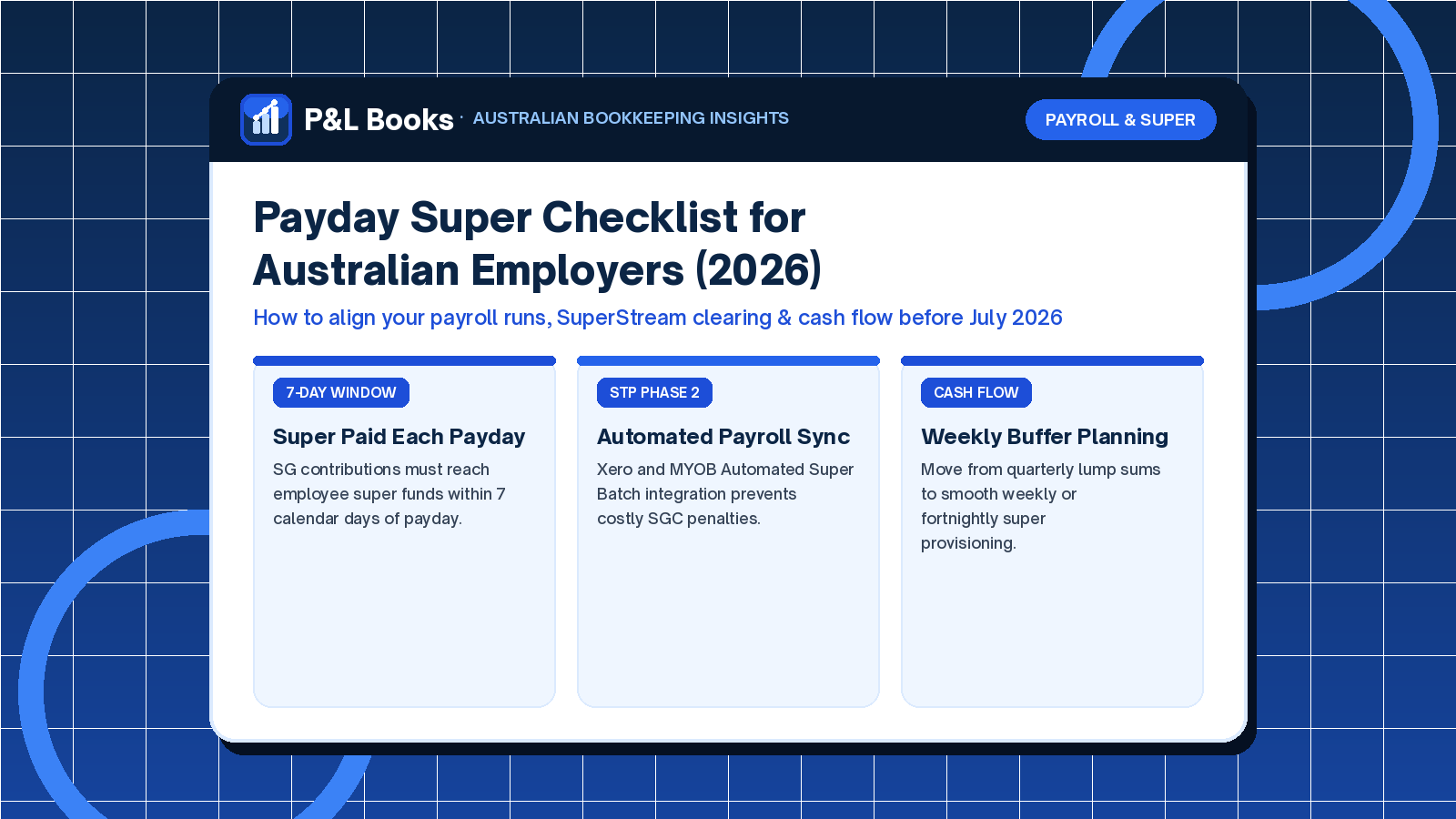
Payday Super Australia represents the biggest operational shift in employer superannuation compliance since the introduction of Single Touch Payroll. Instead of holding employee Superannuation Guarantee (SG) contributions in your business bank account and paying them four times a year, Australian employers must now align superannuation payments directly with every single pay run. Whether you pay staff weekly, fortnightly, or monthly, waiting until the end of the quarter is no longer an option.
For small business owners, tradies, and growing companies across Australia, this reform demands two immediate adjustments: faster payroll processing and tighter weekly cash flow management. In this comprehensive guide, our Australian remote bookkeeping and payroll specialists walk you through how Payday Super works and how to keep your business 100% compliant.
What Is Payday Super Australia and Why Did the Rules Change?
Historically, Australian employers only needed to pay Superannuation Guarantee contributions 28 days after the end of each financial quarter. While that quarterly schedule gave businesses a temporary cash buffer, the Australian Taxation Office (ATO) identified billions of dollars in unpaid super each year, particularly when small businesses experienced cash flow strain.
Under the Payday Super Australia framework, employers are required to pay SG contributions at the same time they pay ordinary time earnings (OTE) to their employees. Specifically, the contribution must reach the employee’s superannuation fund within 7 calendar days of payday. Furthermore, because the ATO now receives real-time payroll data through Single Touch Payroll (STP Phase 2) and real-time contribution reports from super funds, late payments are detected automatically.
Key Compliance Rule for 2026
Your obligation is measured by when the superannuation fund receives and allocates the funds—not the day you click approve in your bank account. Because SuperStream clearing houses take 2 to 4 business days to settle electronic transfers, you must submit your super batch on payday itself.
How the 7-Day SuperStream Clearing Window Works
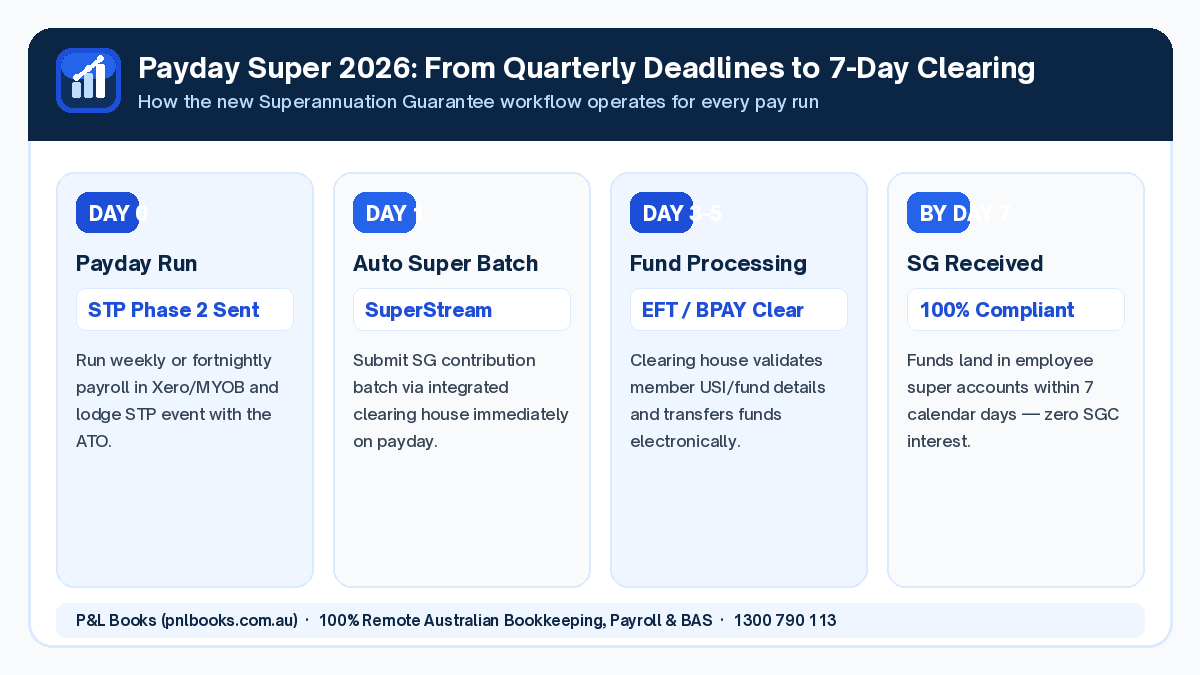
Many employers assume that transferring money to a clearing house on day six satisfies the law. However, bank processing times and clearing house validation rules mean a last-minute transfer will almost certainly arrive late. Consequently, understanding the four-stage clearing timeline is essential for avoiding the Superannuation Guarantee Charge (SGC).
Step 1: Finalise Payroll and Lodge STP Phase 2 on Day 0
First, process your weekly or fortnightly pay run in Xero or MYOB and file your STP Phase 2 declaration immediately. Your STP submission tells the ATO the exact Ordinary Time Earnings and super liability accrued for that pay cycle.
Step 2: Trigger Your Automated Super Batch Within 24 Hours
Second, submit your SuperStream batch on the same day you pay wages. If you use Xero Automated Superannuation or MYOB’s built-in clearing house, you can approve the batch via SMS code in less than two minutes.
Step 3: Audit Employee Fund Details Before Their First Pay
Third, verify every new starter’s USI, member number, and stapled super fund details before they enter your payroll run. Under Payday Super Australia, a bounced contribution caused by an invalid member number can push you past the 7-day deadline unless corrected immediately.
Cash Flow Adjustments for Weekly and Fortnightly Employers
Transitioning from quarterly lump sums to Payday Super requires a one-off cash flow bridge. Previously, an employer with a $10,000 weekly wage bill might hold $15,600 in accrued super across a 13-week quarter before paying it out. Now, that $1,200 super payment leaves your bank account every single week alongside wages.
| Payroll Frequency | Old Quarterly System | New Payday Super System | Bookkeeping Action Required |
|---|---|---|---|
| Weekly Payroll | 4 super batches per year | 52 super batches per year | Automate SuperStream inside Xero/MYOB |
| Fortnightly Payroll | 4 super batches per year | 26 super batches per year | Reconcile super clearing account every fortnight |
| Monthly Payroll | 4 super batches per year | 12 super batches per year | Include super in monthly cash flow forecast |
To keep your working capital healthy during this transition, we recommend opening a dedicated high-interest GST, PAYG, and Super buffer account. Every time customer invoices are paid, transfer your tax and payroll provisions immediately so your operating account shows your true spendable cash.
5-Point Payday Super Australia Checklist for Small Businesses
- Audit your Ordinary Time Earnings (OTE) mapping: Check every pay item, allowance, and bonus category in Xero or MYOB against Fair Work and ATO rules so super calculates accurately on every payslip.
- Upgrade to an integrated clearing house: Replace manual CSV uploads to external portals with direct auto-super inside your cloud accounting software.
- Switch to digital employee onboarding: Collect TFN declarations and super choice forms digitally before a new employee works their first shift.
- Reconcile your Superannuation Payable account weekly: Ensure every payroll accrual matches the exact direct debit leaving your bank feed.
- Partner with a dedicated remote bookkeeper: Let a specialist team manage your weekly pay runs, STP filings, and super batches so you never miss a 7-day window.
How P&L Books Keeps Your Payroll and Super Effortless
At P&L Books, we manage weekly and fortnightly payroll, STP Phase 2 compliance, and Payday Super Australia batches for small businesses across Brisbane, Sydney, Melbourne, Perth, Adelaide, and regional Australia. With transparent bookkeeping packages starting from $65/hr, $74.75/week, or $299/month (including BAS), our Australian team takes the stress out of payroll compliance.
Need strategic company tax planning or end-of-year income tax returns alongside your bookkeeping? We work seamlessly with our specialist tax partner BN Tax so your payroll, BAS, and annual tax returns stay aligned under one roof. Contact P&L Books today or call 0480 005 253 for a free bookkeeping and payroll review.