
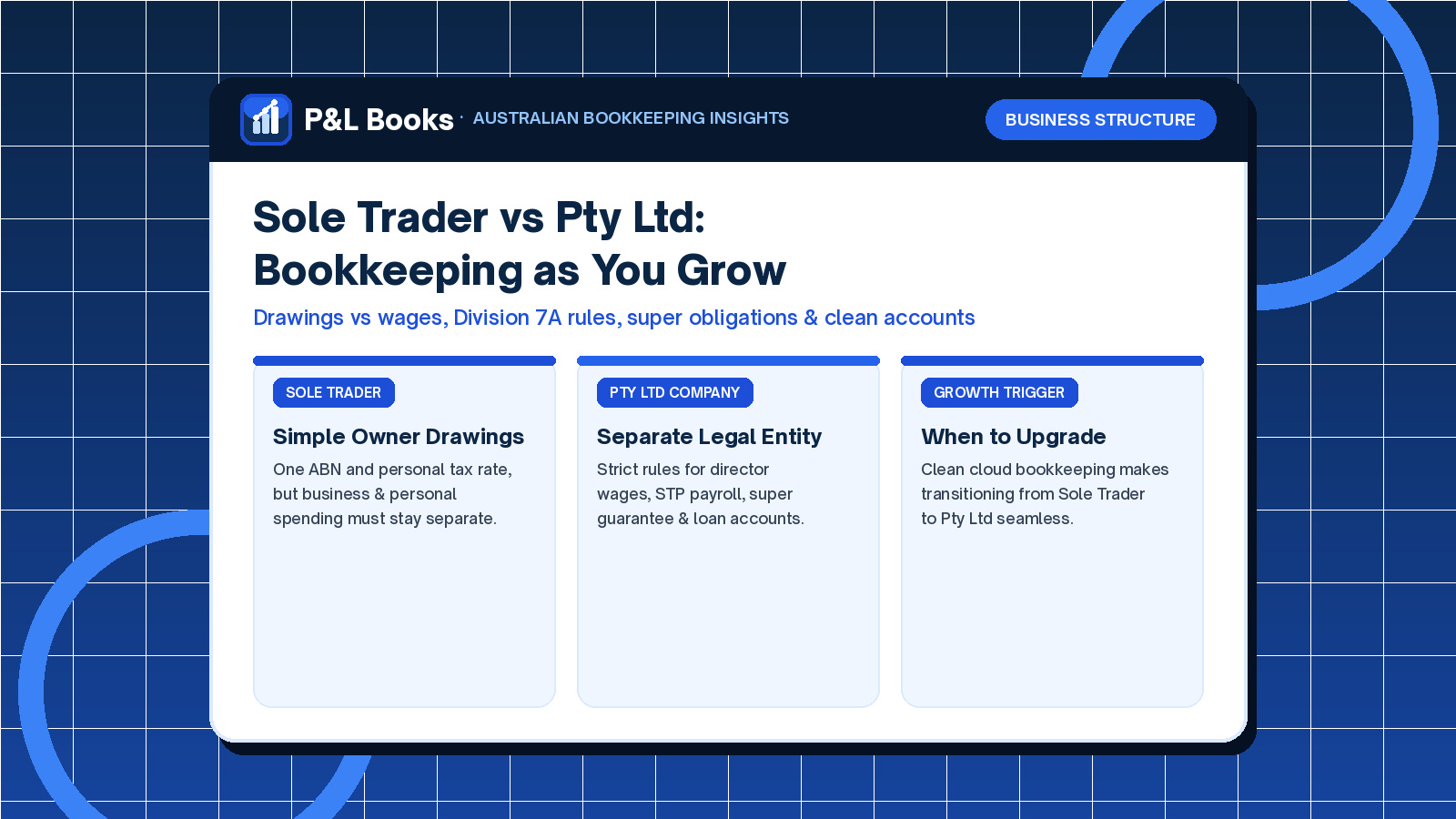
Understanding the practical differences between sole trader vs Pty Ltd bookkeeping is crucial for every growing Australian business owner. When you first launch a trade, consulting practice, or online store, operating as a sole trader offers simplicity and low setup costs. However, as your revenue climbs past $150,000 or you begin hiring staff, transitioning to a proprietary limited (Pty Ltd) company often becomes attractive for asset protection and tax planning.
While many business owners focus on the difference in income tax rates, the day-to-day bookkeeping rules between the two structures are completely different. Treating a company bank account like a personal sole trader wallet is one of the fastest ways to trigger costly tax adjustments. In this guide, our Australian remote bookkeeping team explains exactly how to manage your books under both structures.
The Core Difference in Sole Trader vs Pty Ltd Bookkeeping
The fundamental rule behind sole trader vs Pty Ltd bookkeeping comes down to legal identity. As a sole trader, you and your business are legally the same person. Your business profits are taxed at your individual marginal tax rate, and the cash left in your business bank account belongs to you personally.
By contrast, a Pty Ltd company registered with ASIC is a completely separate legal entity. The money sitting in a company bank account belongs to the company—not to you as an individual director or shareholder. Consequently, every dollar that moves between the company and your personal life must be formally documented as wages, superannuation, dividends, reimbursements, or a director loan.
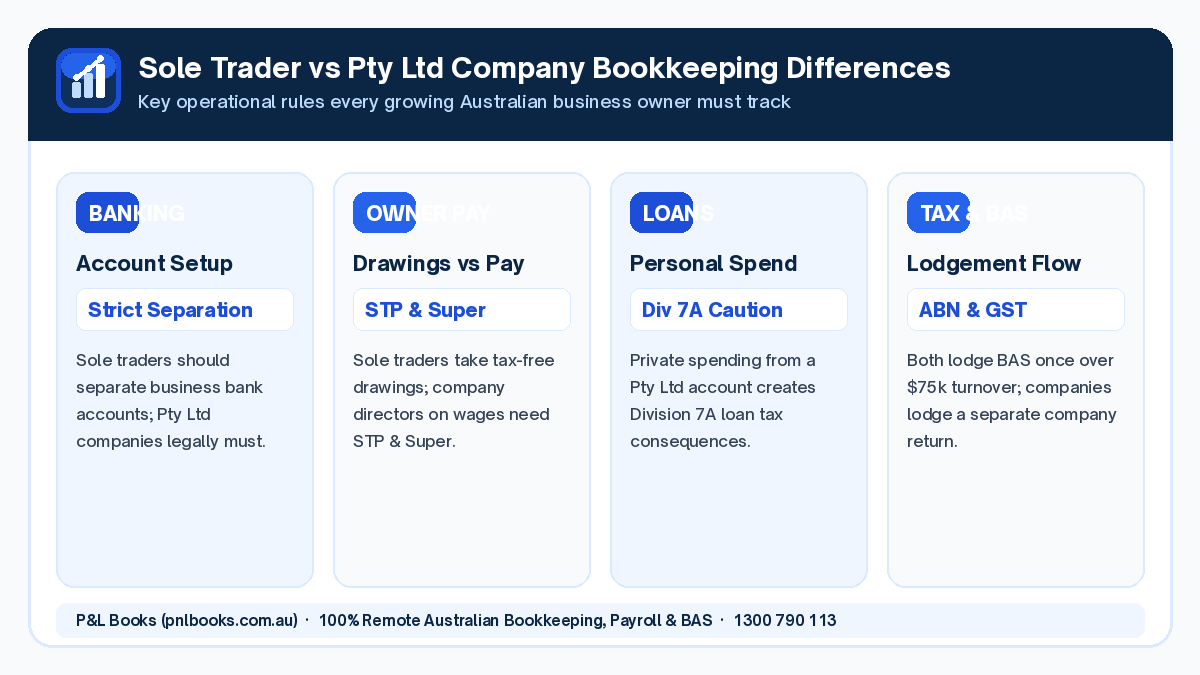
4 Bookkeeping Areas That Change When You Incorporate
1. Business Bank Accounts and Personal Spending
Although the ATO does not legally force sole traders to open a dedicated business bank account, mixing groceries, fuel, and family expenses with business income creates a bookkeeping nightmare. You end up paying your bookkeeper to sort through hundreds of private transactions every quarter.
For a Pty Ltd company, a dedicated company bank account in the company’s legal name is mandatory. Furthermore, every private expense accidentally paid with a company card must be coded to your Director Loan Account and repaid—or properly structured—before 30 June to avoid punitive Division 7A tax consequences.
2. How You Pay Yourself: Drawings vs Director Wages
In sole trader vs Pty Ltd bookkeeping, owner remuneration works in two distinct ways:
- Sole Trader Drawings: When a sole trader transfers money to their personal account, it is coded as “Owner Drawings” on the Balance Sheet (BAS Excluded). You do not put yourself on Single Touch Payroll (STP), and you do not deduct PAYG withholding from your own drawings. Instead, you pay tax via quarterly PAYG Instalments based on net business profit.
- Company Director Wages & Super: When you pay yourself a regular salary or director’s fee from a Pty Ltd company, the company must register for PAYG Withholding, report every pay run via STP Phase 2, and pay Superannuation Guarantee (SG) contributions into your super fund under Payday Super rules.
3. GST Registration and Quarterly BAS Lodgements
Regardless of whether you operate as a sole trader or a Pty Ltd company, GST registration becomes compulsory once your gross annual turnover reaches (or is projected to reach) $75,000 ($150,000 for non-profit organisations), or from day one if you provide rideshare/taxi services. Both structures lodge Business Activity Statements (BAS) quarterly or monthly.
| Bookkeeping Feature | Sole Trader Structure | Pty Ltd Company Structure |
|---|---|---|
| Separate Bank Account | Strongly recommended for clean books | Strictly mandatory under corporate law |
| Paying the Owner | Owner Drawings (Equity account, no STP) | Director Wages (STP Phase 2 + Super) or Dividends |
| Personal Use of Funds | Tracked as private drawings / apportionment | Tracked via Director Loan Account (Division 7A rules) |
| GST & BAS Threshold | Compulsory at $75,000+ turnover | Compulsory at $75,000+ turnover |
4. Transitioning Your Xero or MYOB File From Sole Trader to Pty Ltd
If you are upgrading from a sole trader to a new Pty Ltd company, never simply rename your existing Xero organisation and keep invoicing under your old file. Because your new company has a brand-new ABN, ACN, and bank account, your bookkeeper should set up a fresh Xero subscription from your incorporation date. This ensures your sole trader debtors, creditors, and final BAS remain cleanly separated from the new company’s opening balances.
Planning a Restructure? Coordinate Your Bookkeeper and Tax Agent
Before switching structures, speak with a tax advisor at BN Tax to assess capital gains tax rollover relief and company setup, then let P&L Books configure your new Xero chart of accounts, payroll, and bank feeds.
Real-World Example: Upgrading From Sole Trader to Pty Ltd
Consider an electrical contractor in Brisbane earning $240,000 in gross revenue with $95,000 in materials and vehicle overheads. As a sole trader, the entire $145,000 net profit is taxed in the owner’s personal name at marginal rates, and any cash left in the bank is treated as personal funds. Once that contractor incorporates as a Pty Ltd company and hires an apprentice, the bookkeeping workflow shifts immediately. The company opens a dedicated business transaction account and a separate GST & Super savings account. The director receives a regular fortnightly salary processed through Xero Payroll with STP Phase 2 reporting and 12% Payday Super contributions, while remaining company profits are taxed at the 25% base rate entity company tax rate.
Frequently Asked Questions: Sole Trader vs Company Books
- Can I keep using my personal bank account if I am a sole trader? While not illegal, mixing personal and business expenses increases bookkeeping time and makes ATO substantiation difficult. A separate free business bank account saves hours every quarter.
- Do I have to pay myself superannuation as a sole trader? Sole traders are not required to pay compulsory Superannuation Guarantee for themselves, though personal concessional contributions can be tax-deductible. Company directors paid wages must receive compulsory SG.
- What happens if I pay for family groceries on the company card? Your bookkeeper must code that transaction to your Director Loan Account rather than claiming it as a business deduction or claiming GST credits.
How P&L Books Supports Sole Traders and Pty Ltd Companies
Whether you are a sole trader tradie wanting simple weekly reconciliations or a multi-director Pty Ltd company requiring full payroll, debtor tracking, and management reporting, P&L Books scales with you. Explore our transparent packages from $65/hr, $74.75/week, or $299/month (including BAS), or contact our Australian team on 1300 790 113 for a tailored quote.